

The Mathematical Gazette Pdf 2019
We use cookies to distinguish you from other users and to provide you with a better experience on our websites. Close this message to accept cookies or find out how to manage your cookie settings.


- View selected items
- Save to my bookmarks
- Export citations
- Download PDF (zip)
- Send to Kindle
- Send to Dropbox
- Send to Google Drive
Volume 103 - Issue 558 - November 2019
Contents
Obituary
-
Margaret E Rayner 21st August 1929 – 31st May 2019
- Published online by Cambridge University Press: 21 October 2019 , pp. 385-387
-
- Article
-
- You have access Access
-
- Export citation
Articles
-
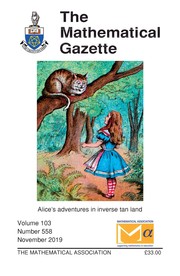
Alice's adventures in inverse tan land – mathematical argument, language and proof
- Paul Glaister
- Published online by Cambridge University Press: 21 October 2019 , pp. 388-400
-
- Article
-
- You have access Access
-
- Export citation
-
-
Andrew Palfreyman's article [1] reminds us of the result (1)
$${\rm{ta}}{{\rm{n}}^{{\rm{ - 1}}}}{\rm{ + ta}}{{\rm{n}}^{{\rm{ - 1}}}}\,2{\rm{ + ta}}{{\rm{n}}^{{\rm{ - 1}}}}{\rm{ 3 = }}\,\pi {\rm{, }}$$

having been set the challenge of finding the value of the left-hand side by his head of department at the start of a departmental meeting.
-
-
New proofs of certain characterisations of cyclic circumscriptible quadrilaterals
- Sadi Abu-Saymeh, Mowaffaq Hajja
- Published online by Cambridge University Press: 21 October 2019 , pp. 401-408
-
- Article
-
- Get access
-
- Export citation
-
-
A convex quadrilateral ABCD is called circumscriptible or tangential if it admits an incircle, i.e. a circle that touches all of its sides. A typical circumscriptible quadrilateral is depicted in Figure 1, where the incircle of ABCD touches the sides at, Aʹ, Bʹ, Cʹ and Dʹ. Notice that labellings such as AAʹ = ADʹ = a are justified by the fact that two tangents from a point to a circle have equal lengths (a, b, c and d in Figure 1 are called tangent lengths). This simple fact also implies that if x, y, and z are the angles shown in the figure, then x = y. In fact, if AD and BC are parallel, then x = y = 90°. Otherwise, the extensions of AD and BC would meet, say at Q, with QDʹ. Hence x = y. Thus x = y in all cases, and sin x = sin y = sin z. We shall use this observation freely. Also we shall denote the vertices and vertex angles of a polygon by the same letters, but after making sure that no confusion may arise.
-
-
Coincidence of the barycentre and the geometric centre of weighted points
- Ulrich Abel
- Published online by Cambridge University Press: 21 October 2019 , pp. 409-415
-
- Article
-
- Get access
-
- Export citation
-
-
Recently, Gerhard J. Woeginger [1] gave a survey on the interesting history of results on equiangular n-vertex polygons with edge lengths in arithmetic progression. Such a polygon exists if, and only if, n has at least two distinct prime factors.
-
-
Characterisations of the parabola
- Steven J. Kilner, David L. Farnsworth
- Published online by Cambridge University Press: 21 October 2019 , pp. 416-430
-
- Article
-
- Get access
-
- Export citation
-
-
Three familiar properties of a parabola are that it is the locus of points that are equidistant from the focus and the directrix, that it can be created by an intersection of a plane and a cone, and that incoming rays parallel to the axis are reflected to a single point. The first two are often used as definitions, and the third may be used as an alternative definition or characterisation.
-
-
The Chinese Ring puzzle, the Crazy Elephant Dance puzzle, the b-Spinout puzzle, and Gray codes
- Curtis Cooper
- Published online by Cambridge University Press: 21 October 2019 , pp. 431-441
-
- Article
-
- Get access
-
- Export citation
-
-
The Chinese Ring puzzle consists of a long loop with a handle on one end and nine rings entwined on the loop (see Figure 1).
-
-
The morphology of
 ${\mathbb{Z}}\sqrt {{\rm{[10]}}} $
 - Andrew J. Simoson
- Published online by Cambridge University Press: 21 October 2019 , pp. 442-460
-
- Article
-
- Get access
-
- Export citation
-
-
What are the units, irreducibles, and primes of the ring
 ${\mathbb{Z}}\sqrt n $ , the set of all numbers
  $a + b\sqrt n $ where a and b are integers and n is a fixed positive square-free integer? In the ring
  ${\mathbb{Z}}$ , primes and irreducibles are synonymous and its units are ±1.
  ${\mathbb{Z}}\sqrt n $ is wilder, and our modest goal here is to catalogue all such numbers for
  ${\mathbb{Z}}\sqrt {{\rm{[10]}}} $ , where a and b range from 0 to 10; the result appears in Figure 1. Here are a few teasers that may induce a reader to read on:
  $3 + \sqrt {10} $ is a unit; 2, 3, 5, and 7 are irreducibles, but not 31; and 7 is the least positive integer that is prime in both
  ${\mathbb{Z}}$ and
  ${\mathbb{Z}}\sqrt {{\rm{[10]}}} $ .
-
Other
-
In the pipeline for March 2020
- Published online by Cambridge University Press: 21 October 2019 , p. 460
-
- Article
-
- Get access
-
- Export citation
Articles
-
A diagram for inequalities of symmetric functions
- Stan Dolan
- Published online by Cambridge University Press: 21 October 2019 , pp. 461-470
-
- Article
-
- Get access
-
- Export citation
-
-
Consider the problem of proving that, for any positive numbers x, y and z,
 $${\rm{9 (}}{{\rm{x}}^{\rm{3}}}{\rm{ + }}{{\rm{y}}^{\rm{3}}}{\rm{ + }}{{\rm{z}}^{\rm{3}}}{\rm{) }} \ge {\rm{ (x + y + z}}{{\rm{)}}^{\rm{3}}}{\rm{ }}{\rm{.}}$$
 This is an example of a type of inequality that frequently occurs in Olympiad-style problems, [1]. These problems may involve symmetric functions of more or fewer variables than the three used here. However, three variables are commonly used and appear to give appropriately difficult problems without making excessive computational demands.
-
-
Eight formulae for the area of triangle OIH
- Martin Josefsson
- Published online by Cambridge University Press: 21 October 2019 , pp. 471-479
-
- Article
-
- Get access
-
- Export citation
-
-
Which is your favourite formula in triangle geometry? Mine is definitely the formula for the area of triangle OIH . It is well known that the perpendicular bisectors to the sides of any triangle are concurrent at a point O (centre of the circumcircle), that the angle bisectors to the vertex angles are concurrent at a point I (centre of the incircle), and that the altitudes are concurrent at a point H. If the triangle is not isosceles, then these three points are all different and uniquely determine a new triangle OIH (see Figure 1), whose area can be expressed in terms of the sides a, b, c of the original triangle. I derived such a formula 20 years ago, and later found out that it had been studied a century earlier.
-
-
Iterating circum-medial triangles
- Hans Humenberger, Franz Embacher
- Published online by Cambridge University Press: 21 October 2019 , pp. 480-487
-
- Article
-
- Get access
-
- Export citation
-
-
When considering 'convergence' many people think of number sequences or contexts arising from calculus. But there are also interesting phenomena of convergence – easy to visualize – arising in elementary geometry. Some of them are so elementary that they can be dealt with at school, for instance an example of iteration that is described in [1, p. 171f] (see also [2, p. 59], [3, p. 222f] and [4, p. 42ff]).
-
Other
-
An Appreciation
- Gerry Leversha
- Published online by Cambridge University Press: 21 October 2019 , p. 488
-
- Article
-
- Get access
-
- Export citation
Notes
-
103.30 Tests for divisibility by prime numbers
- Mehdi Hassani
- Published online by Cambridge University Press: 21 October 2019 , pp. 494-495
-
- Article
-
- Get access
-
- Export citation
-
103.31 Factorising numbers with oracles
- Peter Shiu
- Published online by Cambridge University Press: 21 October 2019 , pp. 495-499
-
- Article
-
- Get access
-
- Export citation
-
103.35 Hölder's inequality revisited
- K. Razminia
- Published online by Cambridge University Press: 21 October 2019 , pp. 512-514
-
- Article
-
- Get access
-
- Export citation
The Mathematical Gazette Pdf 2019
Source: https://www.cambridge.org/core/journals/mathematical-gazette/issue/59A96AB284C6D2A54699A8F59C64D88C
Posted by: tollethaludere.blogspot.com
0 Response to "The Mathematical Gazette Pdf 2019"
Post a Comment